Thursday, April 28, 2011

GDP, Inflation, and Q1 2011

The Government has released the first estimate of Q1 2011 GDP and its details.

In summary it states:


The price index for gross domestic purchases, which measures prices paid by U.S. residents, increased 3.8 percent in the first quarter, compared with an increase of 2.1 percent in the fourth. Excluding food and energy prices, the price index for gross domestic purchases increased 2.2 percent in the first quarter, compared with an increase of 1.1 percent in the fourth.

Real personal consumption expenditures increased 2.7 percent in the first quarter, compared with an increase of 4.0 percent in the fourth. Durable goods increased 10.6 percent, compared with an increase of 21.1 percent. Nondurable goods increased 2.1 percent, compared with an increase of 4.1 percent. Services increased 1.7 percent, compared with an increase of 1.5 percent.

Real nonresidential fixed investment increased 1.8 percent in the first quarter, compared with an increase of 7.7 percent in the fourth. Nonresidential structures decreased 21.7 percent, in contrast to an increase of 7.6 percent. Equipment and software increased 11.6 percent, compared with an increase of 7.7 percent. Real residential fixed investment decreased 4.1 percent, in contrast to an increase of 3.3 percent.

Real exports of goods and services increased 4.9 percent in the first quarter, compared with an increase of 8.6 percent in the fourth. Real imports of goods and services increased 4.4 percent, in contrast to a decrease of 12.6 percent.

Real federal government consumption expenditures and gross investment decreased 7.9 percent in the first quarter, compared with a decrease of 0.3 percent in the fourth. National defense decreased 11.7 percent, compared with a decrease of 2.2 percent. Nondefense increased 0.1 percent, compared with an increase of 3.7 percent. Real state and local government consumption expenditures and gross investment decreased 3.3 percent, compared with a decrease of 2.6 percent.

The change in real private inventories added 0.93 percentage point to the first-quarter change in real GDP after subtracting 3.42 percentage points from the fourth-quarter change. Private businesses increased inventories $43.8 billion in the first quarter, following increases of $16.2 billion in the fourth quarter and $121.4 billion in the third.

Now we can look at some of the details. Remember that GDP or Y is:

Y=C+G+I+Ex-Im

First, it is worth a quick look at the Monetary Base. It may be useful to read our paper from mid 2009 on the Monetary Base as a refresher. The FED has done QE1 which we see with TARP gave rise to the first bump up and then did QE2 with the second recent bump up. This is simply the printing of money.

Now we show M2 and the MB. Note that QE1 has leaked out into the M2 flow, the lag being almost a year. We see the start of QE1 in later 2008 and we see the rise in M2 a year later. Slow but there it is. We expect a similar rise in M2 after QE2. Remember that M2 will drive inflation.

Using classic economic theory we can calculate the inflation based upon GDP, M2 and the velocity. This is shown above. We see a 2% pa rate based upon the past data. Remember this is past and the spikes in M2 will be significant.

The above shows the details in this calculation. V has decreased a bit which means that people are really not turning their money over as quickly.


The above shows PPI and CPI. The major concern is PPI increases, a leading indicator. We show the present changes below.


The above is the worrisome chart. We see a steady rise in PPI and a 6 month moving average annualized rate of increase of 10%. Now the CPI is at 5% but it is a lagger. Our concern is that:

1. The GDP backward looking inflation of 2% is deceptive since the MB is lagging in terms of the M2 impact.

2. PPI is a leading indicator and quarter to quarter fluctuations are acceptable but 6 month moving averages with 100% increases are quite worrisome.

3. CPI is a lagger and we expect it lags the PPI by a year at times. This means that we can expect a 10% inflation rate in the summer of 2012.

Interesting.

Wednesday, April 27, 2011

Chronic Disease and Costs

There once was a time that people got sick and died. One of the major achievements of modern medicine is that we can now keep many of these people alive for a very long time and at a very high cost. Thus one of the drivers for the ever increasing health care costs is the ever increasing prevalence of chronic disease and the ever increasing ability of medicine to keep these people alive longer yet at an ever increasing cost. Yet these are preventable chronic diseases which for the most part are preventable as we had shown in our book on Health Care.

Science states today:

Diabetes, heart disease, and cancer now cause more deaths worldwide than all other diseases combined, according to the first global status report on noncommunicable diseases (NCDs) released at the WHO Global Forum in Moscow today. Communicable diseases such as malaria and AIDS are now outpaced by NCDs in every region except Africa. Chronic diseases, many of which are preventable, accounted for 63% of the 57 million deaths worldwide in 2008. Of those 36 million deaths, 80% occurred in low- or middle-income countries. 

Health leaders from around the world are continuing to meet in Moscow the rest of this week to prepare for the United Nations summit on NCDs in September. It will be only the second U.N. summit convened to address a health issue; the first, held in 2001, focused on AIDS and led to the creation of the Global Fund. 

The 100-page report aims to establish a baseline for the risks of NCDs, measure their prevalence, examine the progress various countries are making in dealing with NCDs, and outline what steps countries can take to both prevent and combat NCDs. 

"The good news," WHO Director-General Margaret Chan said in a press conference today, "is that these diseases are preventable." The report identified smoking, alcohol use, insufficient physical activity, and poor diet as the major risk factors. The report predicts that even African countries will suffer more deaths from NCDs by 2020 than from transmissible diseases and poverty-related issues such as malnutrition and maternal deaths. A 15% increase in mortality from NCDs is expected worldwide in the next decade. 

We have argued quantitatively that if we treat and prevent then we can almost half our current health care expenditures. One wonders why no one in the current Administration has raised this issue.

Monday, April 25, 2011

The Grocery Store

Boudreaux presents an excellent metaphor for Government control in describing what if the Government controlled grocery stores as compared to Government controlling schools. The problem is that was the way it was in the old Soviet Union.

I remember the late 70s in Moscow, February, 20 below in F, the dry crunch of snow, the limited lights, the empty streets, the smell of kerosene and Borstch coming from the compounds of apartments hidden behind the carriage entry ways, and of course the ever present KGB. The Magazin, the stores, with no signs, each carefully set at basement level, each assigned in a well planned manner to distributed the planned foods to the workers. Vodka always cheap, food always rather poor if you were truly just a worker.

I believe Boudreaux needs to see the reality of this view, for it is much worse than what he could imagine, it is like many NYC public schools!

Sunday, April 24, 2011

Are They Both Wrong?

Between Ryan and Krugman we have two extremes. Ryan wants to throw folks on the market, even folks who may have been paying into Medicare for 40+ years, yes I stated working at 12 and paid SSI at 14! Child labor, no, NYC gave work permits to deliver newspapers and somehow at 14 I worked in an HMO in NY as an assistant to a group of physicians. Could never do that now but that is another story.

Back to Ryan, if I were 15 years or more younger then I would get Ryan Care, namely a check for something at some age most likely letter than 65 and told go fish, namely find an insurer. Krugman is spot on this time, try and find a policy. I can get auto insurance pretty simply because I have been doing it for more than half a century. It was also around before that. But old age health insurance, the frauds will be explosive, it will make the banking collapse look like Sunday School efforts. It just will not work and no matter how you try to fix it ab initio there will be a plethora of unintended consequences, just watch the current health care plan.

On the other hand the current Health Care Plan has the same problems, ACO, IFAB, etc etc, it just goes on. Government employees on top of Government employees, it will be the land of zombies.

Somewhere there must be a middle ground. I have made several detailed suggestions but no one in DC seems to even try such an approach. Pity.

Friday, April 22, 2011

Poverty, Chastity and Obedience

Boudreaux presents an interesting counter argument to Krugman. There may very well be a subtext here which could be missing. You see, we pay for attorneys, unless we are unable to and then the state pays for them. We do pay for physicians, unless the state decides it wants to intervene and then the state does pay. We do not have the option to pay for economists, the state chooses them and we are forced to pay for them. What if we could individually choose our economists. You see a bad lawyer, doctor, even an engineer may loose clients or patients but a bad economist may often get a tenure position at a politically correct institution, apparently not George Mason, they seem to put their necks out. What if Princeton, Harvard and even MIT had to?

You see as best I can figure out, you have to take courses from these elite, you cannot select say a different dermatologist because Doctor X is a hack. You cannot select a better lawyer or accountant. As a student you have been convinced that this degree has worth and they you pay based on others decisions. Economics somehow fails the test of the market.

Now for physicians. There is as best I remember no vow of poverty, chastity and obedience in medical school. There was a time when I was in a Franciscan Seminary, but I did not stay, had problems with being told what to do all the time, that obedience problem. So physicians do have to sell themselves. Some are real, well how shall I say it, real jerks, there, it is simple, they may or may not be good, but they are dullards. For many you just memorize the tests and pray you cram through, they are not the ones who asked why. But there is a true market for physicians.

A patient is not forced, at least not yet, to go to a specific physician. They have reputations, for better or worse. There are market decisions made by patients all the time. If a patient has cancer, perhaps they make the market decision of Memorial Sloan Kettering Cancer Center, a long drive, added costs, but most likely a better outcome. There is a decision there, an economic one, even if Krugman fails to see it.

Boudreaux states:

Admittedly, the politically engineered wedge separating the receipt of health-care services from the responsibility for paying for these services creates problems.  But the best way to address these problems is to remove the wedge rather than to arrogantly suggest that some mysterious transcendent force will more reliably look after individuals’ health-care needs than will those individuals themselves as they operate in markets in which insurers and physicians must compete for consumer dollars.

 I would argue that there are elements of economic decisions already in the equation. The problem all too often is the early stage of decisions that led to a life style choice which causes the disease state in the first place. Obesity, smoking, STDs, drinking to excess, all life style choices and all leading to chronic and possibly terminal diseases and costs. Why not charge for that externality, since as it is we all share the pain.

But back to the argument, physicians are not Franciscans, although some people think they should be. They are also economic animals, and with the costs of medical school, and the way funds are politically distributed to students the results may be less than favorable. Think public school teachers!

Medicare: Damned if You Do, Damned if You Don't

There are two threatening clouds for Medicare on the Horizon. One is Ryan and his voucher system. I will get to that shortly. The second is IPAB, the Independent Payment Advisory Board mandated by the new Health Care law.

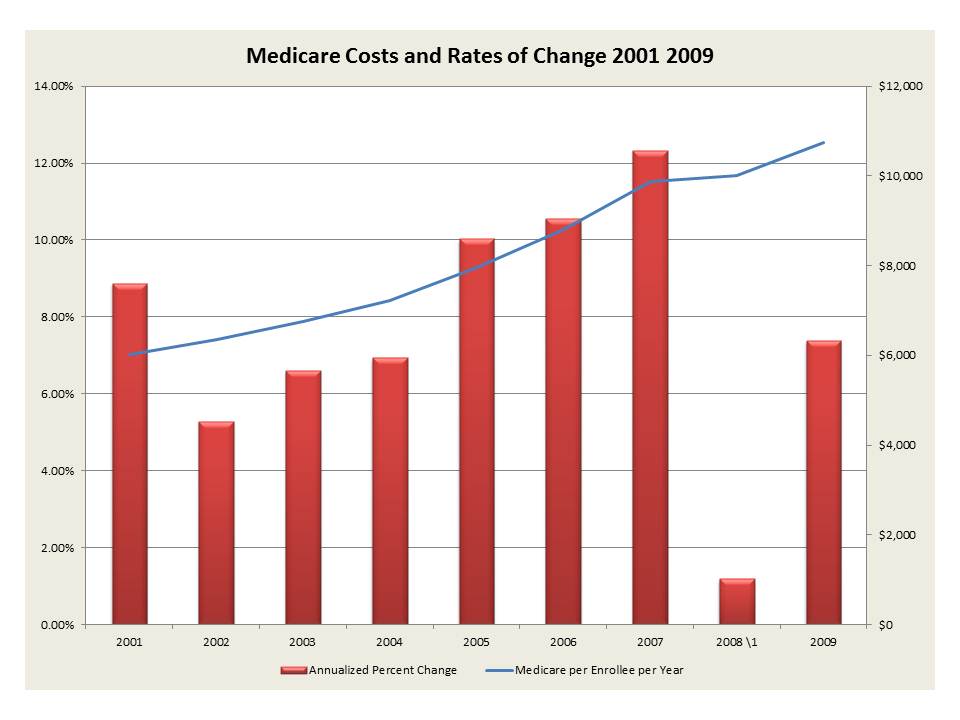
First the Medicare Facts. The chart below based upon Medicare data shows the growth of enrollees and expenditures. Of the almost 48 million enrollees in 2009 about 20% of them are NOT over 65. Frankly they should not be in medicare. They use most of the funds. You see 70% of the Medicare expenditures are used by 10% of the enrollees, and that 20% just mentioned is 90% of that 10%! You see numbers really count.


 Now below we show the costs per enrollee per year. That is what Medicare pays, not what it really costs. Beware Government numbers. The annual growth rates are between 6% and 12%, the highest in 2007 for some unexplained reasons from Medicare. But we now spend $10,500 per annum per recipient. Remember that and remember the growth rate, Ryan does not seem to remember that, because he places that on the backs of those who already paid in!


 Now let us look at a simple example.

1. Let us take our simple example of a real worker, say a high school teacher, a police officer, not one of the highly paid Boston ones, but say a New York patrolman. They start work in say 1970 and retire in 2010. They start at say $12,000 pa after their Rookie Year and then work a real 40 years till 65. They get paid say $105,000 in their final year. Not unreasonable, unless of course you are in Boston and have packed your final year with excess overtime watching man holes.

2. Now assume you paid 3% of your pay each year to some fund, any fund other than the Government, and the fund invested in say Treasury bonds, notes, Ginnie Maes, whatever. The average return would be well in excess of 5% pa. So by 2010 you have $170,000 in that account.

3. Now you retire. You statistically have 12 years left to live. Yes, that is all, some will live longer some less, but you can bet that the average in this large group is 12.

4. Let us assume that health care can be capped at say 6% annual increase and that it starts at $12,000 pa. You can make book on the fact that on average it will cost $127,000 present value to pay for these expenses. Yes, that is $43,000 LESS than what you contributed. But it gets worse you see, since you are also paying $1,200 pa in addition, which is a present value at 65 of say $20,000. That means you are stiffed for not $43,000 but $63,000! Paul Ryan where are you!

5. Now along comes Ryan who proposes:

"When fully phased in, the average payment is $11,000 per year (the average amount Medicare currently spends per beneficiary), and is indexed for inflation by a blended rate of the CPI and the medical care component of the CPI. For affected beneficiaries, the payment replaces all components of the current Medicare Program (Medicare fee-for-service, Medicare Part B, Medicare Advantage, and Medicare Part D). Payment amounts are income-related and risk-adjusted. They also are partially geographically adjusted, with the geographic adjustment phasing out over time."

Why do we not get what we put in! The Ryan Plan clearly sets an instant gap! Medical costs are increasing and the increase if due highly to the people in Medicare who should not be. Do we kick them out? What of all that money we put in? Many left wing haters of the old argue that Medicare beneficiaries are getting a free ride, even some ersatz right wing folks, because some number cruncher took the lower decile of workers and showed they get a free ride. Yes, if you worked at McDonald's as a floor sweep for your entire career you would benefit. But if you did you most likely have other problems as well and may not make it 12 years!

 Now the current Health care Plan has a number of equally troubling issues the most troubling for Medicare is the IPAB. As stated in NEJM:

The ACA alters the landscape for control of federal health care spending by creating new institutions
intended to facilitate progress toward reform and by directly altering payment formulas for Medicare and Medicaid. The new Independent Payment Advisory Board (IPAB) and the Center for Medicare and Medicaid Innovation are charged, respectively, with stewardship of Medicare spending and piloting and diffusion of payment and delivery-system reforms. The IPAB is required to recommend
cost-saving measures for Medicare in years when spending growth exceeds a set target; the changes must be adopted unless equivalent alternatives are substituted or Congress intervenes.


As the CBO stated in December 2009:

The legislation would establish an Independent Payment Advisory Board, which would be required, under certain circumstances, to recommend changes to the Medicare program to limit the rate of growth in that program’s spending. Those recommendations would go into effect automatically unless blocked by subsequent legislative action. In its original estimate, CBO wrote that: “Such recommendations would be required if the Chief Actuary for the Medicare program projected that the program’s spending per beneficiary would grow more rapidly than a measure of inflation (the average of the growth rates of the consumer price index for medical services and the overall index for all urban consumers).” That statement is correct for fiscal years 2015 through 2019. After 2019, however, the threshold for Medicare spending growth that would trigger recommendations for spending reductions would be higher—specifically, the rate of increase in gross domestic product (GDP) per capita plus 1 percentage point.

With this corrected reading, savings from changes to the Medicare program (along with other changes to direct spending that are not associated directly with expanded insurance coverage) would increase at a rate that is between 10 percent and 15 percent per year during the 2020–2029 period, compared with a growth rate of nearly 15 percent reported in the initial estimate. The long-run budgetary effects of the other broad categories of the legislation are unchanged from the initial estimate. All told, CBO expects that the legislation, if enacted, would reduce federal budget deficits over the decade after 2019 relative to those projected under current law—with a total effect during that decade that is in a broad range between one-quarter percent and one-half percent of GDP. In comparison, the extrapolations in the initial estimate implied a reduction in deficits in the 2020–2029 period that would be in a broad range around one-half percent of GDP. The imprecision of these calculations reflects the even greater degree of uncertainty that attends to them, compared with CBO’s 10-year budget estimates. The expected reduction in deficits would represent a small share of the total deficits that would be likely to arise in that decade under current policies.

In effect the IPAB becomes a de facto rationer of health care for those on Medicare. They are NOT medical practitioners, they are politicians! Have we not learned anything over the past couple of years? Do we really want to leave choices for life saving procedures to those who could not find employment elsewhere?