Monday, June 14, 2010

Antitrust Divisions Sues Physicians

The DOJ Antitrust Division, headed by Christine Varney, a former Board member of one of my former companies, sued a set of physicians for refusing to meet Government dictated prices.

The DOJ statement indicates:

The Department of Justice reached a settlement today with the Idaho Orthopaedic Society, an orthopedic practice group and five orthopedists that will prohibit them from conspiring with competing physicians in the Boise, Idaho, area to deny medical care to injured workers and to engage in group boycotts to obtain higher fees. The department said that the defendants and other orthopedists conspired to gain more favorable fees and other contractual terms by agreeing to coordinate their actions, including denying medical care to injured workers and threatening to withdraw from healthcare plans offered by Blue Cross of Idaho. The department said that their conduct caused the state of Idaho and other healthcare consumers to pay higher fees for orthopedic services.

The complaint continues:

According to the complaint, the conspiring orthopedists engaged in two antitrust conspiracies, which took place from 2006 to 2008. In the first conspiracy, through a series of meetings and other communications, the orthopedists agreed not to treat most patients covered by workers' compensation insurance. They entered into a group boycott in order to force the Idaho Industrial Commission to increase the rates at which orthopedists were paid for treating injured workers. The Idaho Industrial Commission sets the fee schedule that determines the amount that orthopedists and other healthcare providers usually receive for treating patients covered by workers' compensation insurance. The boycott resulted in a shortage of orthopedists willing to treat workers' compensation patients, causing higher rates for orthopedic services.

In the second conspiracy, all of the defendants, except David Lamey, and other conspiring orthopedists agreed to threaten to terminate their contracts with Blue Cross of Idaho. They jointly threatened to terminate their contracts to force Blue Cross of Idaho to offer better contract terms to orthopedists.

This is in my opinion a price fixing by the Government akin to what we saw in the early days of FDR. It is Galbraithian and forces eventually all workers to agree to compensation at rates as mandated by the Government. This is a chilling effect on all workers. Worse is yet to come I believe.

FTC and Journalism

We have discussed the proposals of having Government support journalism before, several times over the past year. Recently the FTC issued a paper suggesting a tax on Internet journalists to support the existing but decaying journalists.

The FTC has announced a meeting on June 15 to review and expand their proposals. They state:

The Federal Trade Commission will hold its third and final workshop on the future of journalism at the National Press Club in Washington, DC, on June 15, 2010. Information about the series of workshops can be found at http://www.ftc.gov/opp/workshops/news/index.shtml. An agenda for this third workshop will be posted at a later date.

Consumers are increasingly turning to the Internet for news and information. Advertisers are moving ads to online sites and scaling back on ad buys as a result of the recession, and news organizations are struggling with large debts they took on during better times. As a result, some are questioning how journalism can survive and thrive in the future.

At the June 15 workshop, a small group of experienced journalists, publishers, academics, economists, and other policy experts will compare, contrast, and evaluate the ideas for sustaining journalism that have been set forth in two previous FTC workshops and in a wide variety of reports and conferences. This discussion will help inform potential recommendations to be contained in a report the FTC will release later this fall.

A staff discussion draft that briefly summarizes the state of journalism today, and sets forth the various proposals raised to date, has been posted on the FTC’s website. Through this document, the FTC staff seeks to prompt discussion of whether to recommend policy changes, and, if so, which specific proposals would be most useful, feasible, platform-neutral, resistant to bias, and unlikely to cause unintended consequences in addressing emerging gaps in news coverage. FTC staff anticipates that different workshop participants will criticize or improve some or all proposals, and add ideas of their own. The purpose of the staff discussion draft is precisely to encourage such additional analyses and brainstorming.

This is a highly inappropriate use of Government resources. It is akin to supporting buggy whips when the auto was introduced. It is even worse because it sets the Government up as the supporter of the Press, which can only lead to control.

Wednesday, June 9, 2010

Bernanke, Deficit, Debt

The FED Chairman in the usual subdued tone stated:

Our nation's fiscal position has deteriorated appreciably since the onset of the financial crisis and the recession. The exceptional increase in the deficit has in large part reflected the effects of the weak economy on tax revenues and spending, along with the necessary policy actions taken to ease the recession and steady financial markets. As the economy and financial markets continue to recover, and as the actions taken to provide economic stimulus and promote financial stability are phased out, the budget deficit should narrow over the next few years.

Even after economic and financial conditions have returned to normal, however, in the absence of further policy actions, the federal budget appears to be on an unsustainable path. A variety of projections that extrapolate current policies and make plausible assumptions about the future evolution of the economy show a structural budget gap that is both large relative to the size of the economy and increasing over time.

Unsustainable path indeed. As we have shown yesterday, we are approaching 100% and that is twice what it should be. We are sucking future growth out of the economy and putting it into useless Government programs. The problem is that we soon also will have 2 private sector employees for each Government employee! We are on our way to an amalgam of France and Greece.

Tuesday, June 8, 2010

We are Soon To Get 100% Debt to GDP


The above is a plot of the GDP, Debt and ratio of Debt to GDP. We will soon exceed 100% debt load to GDP. This should be terrifying to all. Just look at what has happened in the past 18 months, we have seen debt go from a 62% load to almost 100%.


The above is the last year alone. There seems to be no stop.


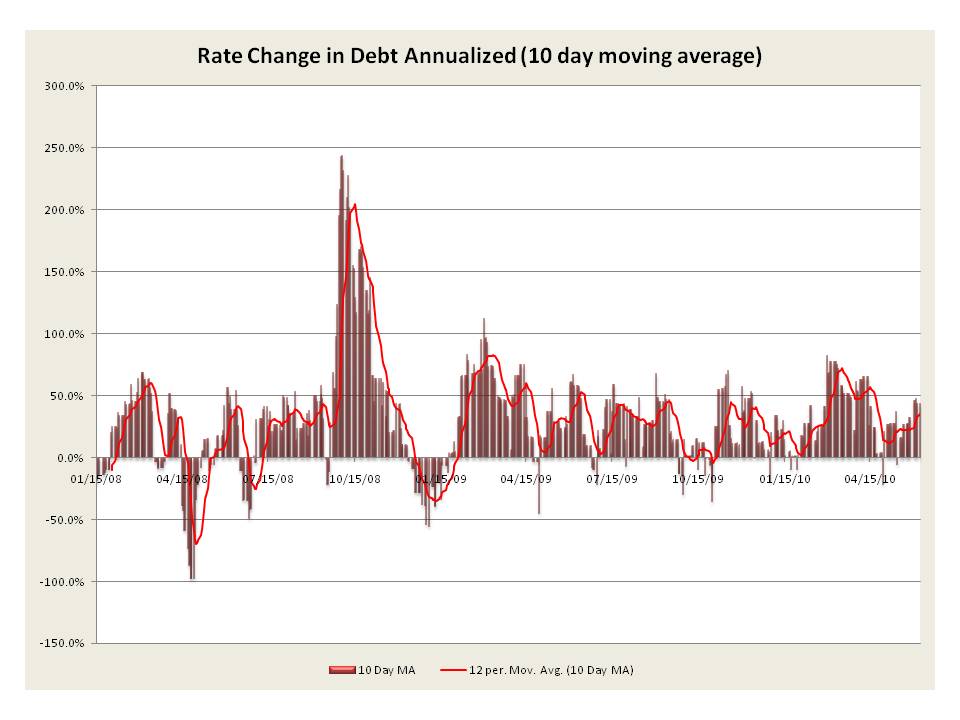
The growth rates are plotted above and show a constant positive growth. This will be unsustainable.

Here is what is happening now. The FED buys junk and prints money and the banks buy Treasuries to keep the engine going.


Now here is what will happen next. The junk will be all on the FED's books, so the FED will now buy the Treasuries, the old ones, print more money, give it to the banks, who will buy more Treasuries. Sound unstable, yes.


The cycle starts up and becomes a positive feedback loop which we engineers know is unstable!


This is what leads to hyperinflation. We are printing like mad men to stay ahead of this bow wave, and it is rapidly catching up on is and DC is clueless.

To summarize here is what is going to happen.


And sooner than later! Hold on to your hats. This will make Carter look like a financial whiz, and I was there then.

More on the Soda Tax

I guess I had better detail the data on the soda tax issue somewhat more for those who may be unfamiliar. Just for those of you who have been following us, we did put a book up on the web a year ago on Health Care Policy plus White Papers detailing the economics of Type 2 Diabetes and Obesity. But here we go again. Hopefully it strikes home. Also the slides on this discussion are available on our web site under Type 2 Diabetes and Obesity.

Let us begin the discussion.

1. First we pose the four questions we need to answer. This we show below.


The issue of what causes Type 2 Diabetes has been looked at by many and generally we all know it is a carbohydrate disorder, along with some lipid and protein issues as well, by as Banting and Best knew from the then clinical practice on Type 1 Diabetes, controlling carbs, near starvation, kept Type 1 patients alive, barely, but Type 2 patients could actually revert to normal if the BMI was brought below 22.5 early on in the disease.

2. If we can answer the above questions then we can put them in a simple economic model for costing out the overall societal costs for Type 2 Diabetes. We summarize that below.


So we can see what the incidence, and in turn prevalence is for T2 Diabetes and then add it to the model. Remember incidence is new cases and prevalence is total so we must add all the above up. Also one must remember that T2 sequellae are long lasting. Unlike lung cancer, where the patient frequently dies quickly, T2 sequallae patients may linger for years, well into the Medicare period as well.

3. Obesity causes T2 Diabetes.


There are multiple papers and books with the latest summary being in Science in 2009 by Lazar. There may still be some rough edges to the analysis, but it is compelling, more so than almost all other studies. There is also the book by Mantzoros on Obesity and Diabetes which provides substantial data through 2005.

One may then ask what causes obesity, for the most part it is simply excess calories, but we will return to that. The answer of the nexus between obesity and T2 Diabetes is unquestionable, the details are a work in progress, and the literature is extensive. Clinically any physician in day to day practice dealing with T2 Diabetes is also confronting obesity. It has been that way for years.

4. The prevalence of T2 Diabetes is increasing significantly. We show the data below. Clearly the growth from 1070 shows the main driver between T2 Diabetes and obesity.


5. If one were to plot the cost of health care as a % of GDP versus the % prevalence of obesity in the US one obtains the curve below.


This curve, albeit statistical, and separate from the studies under 3 above, shows a strong correlation. It shows costs due to obesity taking over the health care expenditures. It shows that there is a strong statistical correlation between obesity and the explosion in health care costs. We will detail that shortly.

6. So what does T2 Diabetes lead to. The next set of questions we posed under 1 above. Well we all know the answer, cardiovascular, nephropathy, neuropathy, retinopathy, and the list goes on!


The problem with these is that they last a long time and cost lots of money. Take a stroke, that can have costs which last decades! Again dramatically unlike smoking and many cancers. Cancers are either cured or they kill you. For the most part we have limited success turning cancer into a chronic disease. CML may become one of the first.

7. Here is some of the most recent data on the sequellae, their incidence, prevalence, and treatment options.


This is quite costly.

8. Looking forward we now have to worry about the lifetime risks of T2 Diabetes. This is shown below.


This means that one third of the people born in 2000 will develop T2 Diabetes! Does anyone really know what that means. It is not the cancer problem, we may have actually solved that by the time this tsunami hits.

9. These are some of the sequellae that this growth will cause.


10. And these are some of the current stats on the disease as we see them today.


11. We now want to goes back to item 2 above to continue to fill in our cost model. This can be followed as below:


We now need to get data for the costs of the sequellae and better stats on their occurence. We do that as follows.

12. The following is a great study which benchmarked all of these costs. It is one of dozens but it is the one which I have come to rely upon.


The study we well done and should be studied.

13. The study performs the steps as we show below. We reached the answer that in 2010 it costs $300 B. That can be demonstrated in the next point.


14. The details of the cost model using the 2007 study yield the following data:


Here we took data for 2008, demographics and prevalence, and then used the study data from Brandle et al to modify the data in the above table. Then we used the cost increase data from 2008 to 2010 and the increased prevalence from 2008 t0 2010 and the increased population from 2008 to 2010 and voila we get $300 B! That is 2X the CDC numbers from 2007. But we argue that the numbers must (i) reflect the up tick as we just described it, and that (ii) the CDC numbers should be adjusted to reflect the Brandle methodology.

15. The following is a summary of my argument from yesterday and the day before regarding costs on a per carb basis.


Here we have laid out the logic and the referring source materials. Is this the definitive study, not yet, it will continue to evolve.

Mankiw responded in his blog yesterday as follows:

When writing my article, I contacted several prominent health economists to ask whether a complete accounting of both budgetary costs and benefits has been done for obesity, as has been done for smoking.

Yes the definitive study has not been completed, most likely will never be done. Yet this analysis and the ones we refer to provide a reasonable basis for policy formulation. The approach here is still one of a "back of the envelope" albeit in my book I have provided adequate detail, perhaps not of the PhD level, but at a level that a rational business person would use to make an informed decision. I would assume that such would apply to politicians, but alas I left DC 30 plus years ago vowing never to return.

This explanation took me a little less than 3 hours, almost half working on getting it on Blogger. Yet I spent almost a year working on the problem, having spent 25 plus years thinking and working in the area. Is this analysis fully buttoned up, no, there are loose ends, but is is a map to the solution, at least one map. Enjoy the journey, but this is a real problem.

One final note, unlike the Pigou tax and the gasoline issue, here with the carb tax there is an alternative. You can stop eating, lose the weight and return to health. At that point you are both health and not paying the tax. No such alternative exists for those who drive.

Update: Just noticed that the National Soft Drink Association hit my blog from yesterday this morning. Just to be fair, my position is not against soda it is carbs in general. As someone who took his BMI from 30.5 to well below 25 eight years ago, and kept it there, I am like an ex-smoker or a religious convert, I am a zealot advocate since I see what works. I have not had a soda in eight years, I remember the day, and I remember it was root beer, I really love root beer, but as a recovering carboholic I remain staunchly against carbs!

Monday, June 7, 2010

Soda Tax and Reality

Leonhardt of the Times responded to Mankiw and his rant about the unfairness of the soda tax. I covered this gross misunderstanding of the principle of equity yesterday but in reading the comments to Leonhardt I truly believe in two things:

1. The public is becoming aware of this as an issue.

2. The public has no clue

and a side observation:

3. Leonhardt tried to do some numbers but he is way off. But I compliment him of doing what the economist fellow from Harvard should have done in the first place. Numbers do have some merit, especially if they are obvious and even more so if done on the back of an envelope.

You see if you are out trying to raise money as I have done many times for my own businesses in foreign lands, then when you make your pitch, you need eye contact, to assure the person on the other side that you know what you are doing, and even though you have all those power point slides they want to know that you know the numbers in your heart...they look at your eyes. The numbers have to be on the napkin, the envelope, whatever, but the numbers must be there. Mankiw in my opinion did not do his homework.

Leonhardt states:

A soda tax obviously would not solve the obesity epidemic. But it appears to be one of the most promising responses, given the central role that sugary drinks play in the epidemic and the fact that they have no nutritional benefit. A tax would also help reverse the big decline in the price of soda over the last few decades, at the same that the price of fruit and vegetables has been rising. Finally, as with a gasoline tax, a soda tax would help cover the broader costs that the product imposes on taxpayers.

But I use a simple metaphor. Let us assume you are an auto, a pickup, an 18 wheeler. You pay a tax on gasoline. But, as an 18 wheeler you also pay a road use tax. Your heavy loads wear out the pavement the rest of us drive on in excess of the gas tax you may pay.

Thus the heavy load 18 wheelers should pay a tax for their costs. Should we weigh people when they file a tax return each year, we already check their health care payment status, why not the weight, we already have invaded parts of the body, why not go for the gold!